
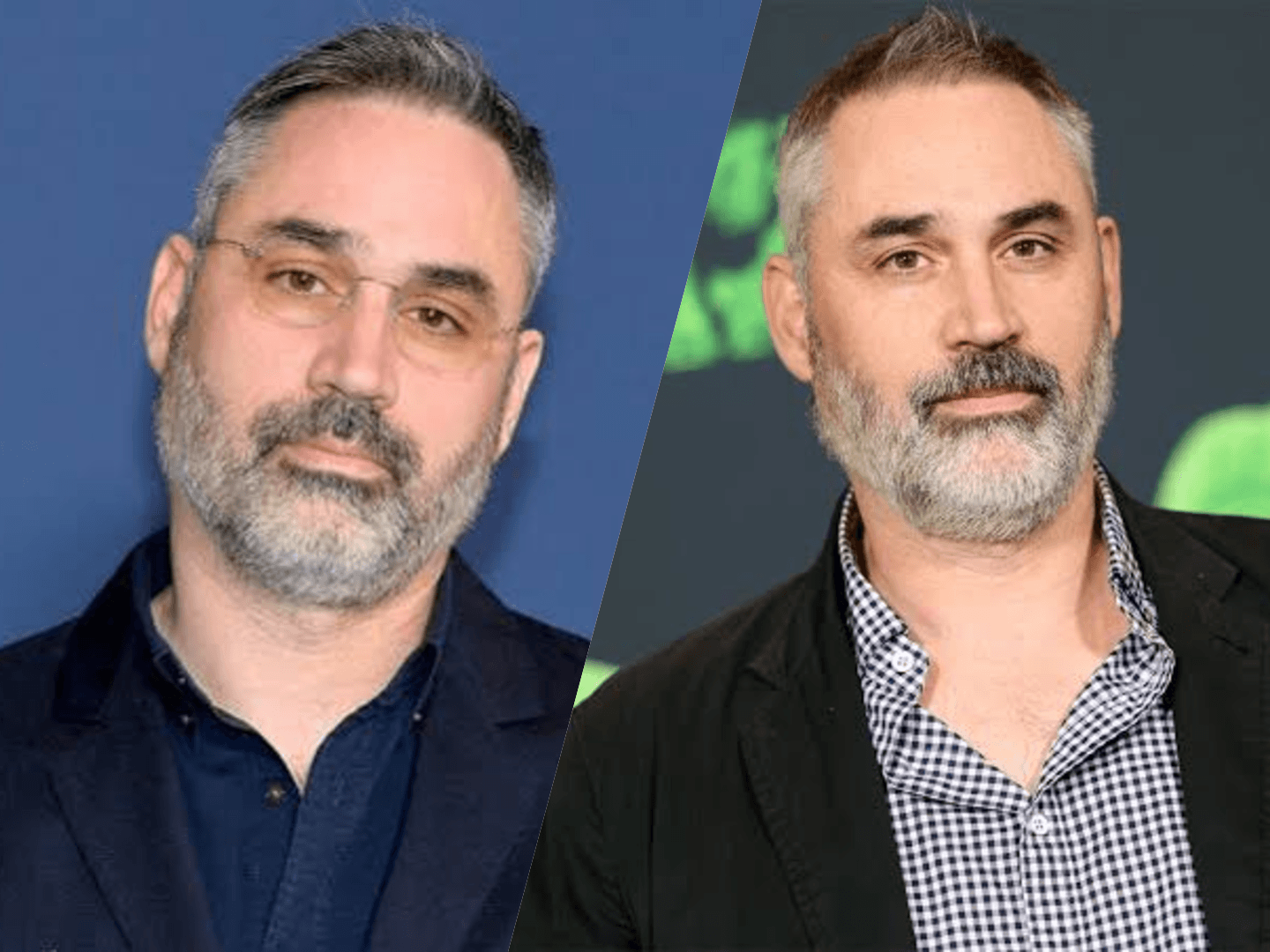
Alex Garland’s movies span science fiction, horror, dystopian drama, and war cinema, with his work including 28 Days Later, Sunshine, Ex Machina, Annihilation, Men, Civil War, and Warfare. He began as a screenwriter before becoming a director, developing a filmography centered on technology, human behavior, societal collapse, and existential uncertainty.
Who Is Alex Garland?
Alex Garland is an English writer and filmmaker whose screen career developed through collaborations with director Danny Boyle. His first major screenplay was 28 Days Later in 2002, following the adaptation of his novel The Beach into Boyle’s 2000 film.
Garland reunited with Boyle for Sunshine, released in 2007, and continued developing a reputation for combining genre storytelling with philosophical questions. His writing frequently examines how individuals behave when familiar social structures, technologies, or assumptions begin to fail.
Garland moved into directing with Ex Machina, establishing himself as a filmmaker as well as a screenwriter. His subsequent movies expanded into science fiction horror, psychological horror, political thriller territory, and war cinema.
Alex Garland Movies: His Complete Film Career
Garland’s filmography is best understood by separating his writing credits from his directing credits. Before directing, he wrote 28 Days Later, Sunshine, Never Let Me Go, and Dredd, while also serving as an executive producer on 28 Weeks Later.
His directorial filmography began with Ex Machina and continued with Annihilation, Men, and Civil War. He later co-directed Warfare with former Iraq War veteran Ray Mendoza, while continuing his involvement with the 28 Days Later franchise as a writer and producer.
One distinction is especially important when discussing Garland movies. 28 Years Later: The Bone Temple, released in 2026, is part of Garland’s continuing franchise work, but he did not direct it. Nia DaCosta directed the film from a screenplay by Garland, with Garland also serving as a producer.
| Field | Details |
|---|---|
| Full Name | Alexander Medawar Garland |
| Age | 56 years old |
| Date of Birth | May 26, 1970 |
| Birthplace | London, England |
| Nationality | British |
| Profession | Author, Screenwriter, Film Director, Producer |
| Height | 6 ft 1 in (1.85 m) |
| Education | University College School; University of Manchester, Art History |
| Years Active | 1996–present |
| Notable Works | The Beach, 28 Days Later, Sunshine, Ex Machina, Annihilation, Men, Civil War, Warfare |
| Awards | Academy Award winner for Ex Machina; British Independent Film Awards recognition |
| Spouse/Partner | Paloma Baeza |
| Social Media | No verified official public social-media account found |
28 Days Later
28 Days Later, released in 2002, was Garland’s breakthrough as a screenwriter and the beginning of his major creative partnership with Danny Boyle. The film follows Jim, played by Cillian Murphy, after he awakens from a coma to discover London devastated by a rapidly spreading infection.
The movie helped redefine the modern infected-survivor thriller by emphasizing speed, atmosphere, isolation, and social breakdown. Although Boyle directed the film, Garland’s screenplay established themes that would repeatedly appear throughout his later work, particularly the fragility of ordinary society under extreme circumstances.
The connection between 28 Days Later and Garland’s later work is especially revealing because both 28 Days Later and Civil War use grounded visual approaches to make extraordinary circumstances feel immediate. Garland has discussed the handheld style associated with 28 Days Later and its contribution to the film’s sense of realism.
Sunshine
Garland reunited with Boyle for Sunshine, released in 2007, writing the screenplay for a science-fiction thriller about astronauts attempting to reignite a dying Sun. The film featured Cillian Murphy, Chris Evans, Michelle Yeoh, and Rose Byrne among its ensemble cast.
Unlike 28 Days Later, Sunshine moves away from a terrestrial catastrophe and places its characters inside an isolated spacecraft. Nevertheless, Garland again explores survival, responsibility, fear, and the consequences of confronting forces larger than individual human beings.
Garland’s thinking about Sunshine was influenced by science and the eventual fate of the universe. His screenplay therefore treats the mission as more than a conventional space adventure, turning humanity’s attempt to survive into a question about extinction and the limits of temporary solutions.
28 Weeks Later
28 Weeks Later arrived in 2007 as a sequel to 28 Days Later. Unlike its predecessor, it was directed by Juan Carlos Fresnadillo, while Garland was involved as an executive producer.
The film expands the world established by Garland’s original screenplay while moving the story forward with a new group of characters and filmmakers. Its inclusion in Garland’s filmography demonstrates his continuing involvement with the franchise without confusing his producing role with directorial authorship.
That distinction is important because Garland did not direct 28 Weeks Later. His involvement was primarily connected to the production and continuation of the franchise he helped establish with the original film.
Never Let Me Go
Garland adapted Kazuo Ishiguro’s novel Never Let Me Go for the screen in 2010. Directed by Mark Romanek, the film stars Carey Mulligan, Andrew Garfield, and Keira Knightley as young people confronting the disturbing reality of their existence.
The film differs substantially from Garland’s more overtly genre-driven projects. Its speculative premise is presented through intimate relationships, memory, love, and mortality, allowing the science-fiction element to remain largely in the background while the characters confront the limits imposed upon their lives.
That approach illustrates an important characteristic of Garland’s writing. Even when he works with familiar science-fiction concepts, he frequently uses them to investigate emotional or philosophical questions rather than treating speculative technology as an end in itself.
Dredd
Garland wrote the screenplay for Dredd, the 2012 adaptation of the long-running Judge Dredd comic-book character. Karl Urban stars as Judge Dredd, a law-enforcement officer operating in a violent futuristic society. The film was directed by Pete Travis.
Dredd stands apart from Garland’s quieter speculative dramas because it is fundamentally an action film. Its compressed setting, violent confrontations, and highly controlled world-building nevertheless fit his recurring interest in institutional power, social breakdown, and individuals attempting to survive within oppressive systems.
There has also been longstanding discussion about Garland’s precise involvement in the film’s production and direction. Garland himself has resisted reducing filmmaking to a single person’s contribution, emphasizing that many people can influence how a finished movie takes shape.
Ex Machina
Ex Machina marked Garland’s transition from established screenwriter to director. Released in 2014 in its original release year, the film stars Alicia Vikander, Domhnall Gleeson, and Oscar Isaac in a tightly controlled story about artificial intelligence and human experimentation.
The story centers on Caleb, a programmer invited to the remote home of technology entrepreneur Nathan. There, Caleb is asked to evaluate Ava, an advanced artificial intelligence housed in a humanoid body. The apparently simple experiment gradually becomes a psychological contest involving trust, control, sexuality, and consciousness.
Ex Machina became an important milestone in Garland’s career because it demonstrated how effectively he could translate his writing interests into visual filmmaking. The film received major recognition, including an Academy Award for Best Visual Effects and BAFTA recognition for Garland’s screenplay.
Annihilation
Garland followed Ex Machina with Annihilation in 2018, adapting Jeff VanderMeer’s novel. The film stars Natalie Portman, Jennifer Jason Leigh, Tessa Thompson, Gina Rodriguez, and Tuva Novotny as members of an expedition entering a mysterious environmental zone known as the Shimmer.
The Shimmer transforms living organisms and disrupts conventional assumptions about nature and identity. Rather than explaining every element through traditional science-fiction exposition, Garland uses the environment to create uncertainty, allowing the characters and audience to experience the unknown simultaneously.
Compared with Ex Machina, Annihilation is much larger in scale but remains similarly interested in transformation. The earlier film asks whether an artificial intelligence can understand humanity, while Annihilation asks what happens when humanity encounters an incomprehensible force capable of changing life itself.
Men
Men, released in 2022, shifted Garland toward folk horror and psychological unease. Jessie Buckley plays Harper, a woman who retreats to the English countryside following a personal tragedy, only to experience increasingly disturbing encounters around her temporary home.
The film also stars Rory Kinnear, who plays multiple characters connected to Harper’s increasingly unsettling experiences. Garland uses repetition, symbolism, and body horror to explore grief, fear, relationships, and patterns of behavior that Harper struggles to escape.
Unlike Annihilation, which builds its mystery around an external phenomenon, Men keeps its horror closely connected to Harper’s emotional experience. Its deliberately ambiguous approach makes it one of Garland’s most interpretive films, inviting viewers to consider its imagery rather than supplying a single straightforward explanation.
Civil War
Civil War, released in 2024, became Garland’s fourth feature as a director. The film stars Kirsten Dunst, Wagner Moura, Cailee Spaeny, and Stephen McKinley Henderson as journalists traveling through a United States consumed by armed conflict.
The film avoids assigning its fictional conflict to a simple real-world political ideology. Instead, Garland presents a fractured United States containing competing factions and focuses on journalists attempting to document the consequences of the violence.
Garland explained that he began writing the screenplay after the COVID-19 pandemic disrupted his sense of how quickly social conditions could change. His interest was not simply in predicting a specific political future, but in examining the destabilizing possibility of societal breakdown.
The film also returns to a visual quality associated with 28 Days Later. Garland has discussed the handheld approach used in both films, linking his earliest major screenplay to one of his most ambitious directorial projects.
Warfare
Warfare, released in 2025, represents another significant change in Garland’s filmmaking. He co-directed the film with Ray Mendoza, who also co-wrote the screenplay with Garland. The collaboration brought Mendoza’s firsthand military experience into a film centered on the realities of combat.
Rather than using speculative settings, Warfare moves into contemporary military drama. That change is significant because Garland’s earlier films frequently examined hypothetical crises, whereas this project approaches war through a more immediate and grounded framework.
The film also fits a broader pattern in Garland’s career. Whether the threat comes from infected humans, artificial intelligence, an alien environment, political collapse, or warfare, his stories repeatedly place human decision-making under extraordinary pressure.
28 Years Later and The Bone Temple
Garland returned to the world of 28 Days Later with 28 Years Later, released in 2025. He wrote the screenplay and produced the film, while Danny Boyle returned to direct. The project reunited the principal creative partnership behind the original film after more than two decades.
The continuation demonstrates how Garland’s early work remains connected to his later concerns. The original film examined what happens when social order collapses because of infection, while the later story expands that world and considers how survivors and new generations might adapt to a transformed society.
The franchise continued with 28 Years Later: The Bone Temple in 2026. Garland wrote the screenplay and served as a producer, while Nia DaCosta directed the film. This makes the movie part of Garland’s filmography without making it one of his directorial works.
What Makes Alex Garland Movies Unique?
A recurring feature of Garland’s movies is the collision between extraordinary circumstances and ordinary human psychology. His characters rarely confront purely external threats because the central tension usually develops from how people respond when familiar rules stop working.
Technology is another recurring concern. Ex Machina examines artificial intelligence, Annihilation explores biological transformation, and Never Let Me Go presents a society built around human cloning. These films use different premises but ultimately ask related questions about identity, mortality, autonomy, and what defines humanity.
Garland also repeatedly examines societal collapse. 28 Days Later depicts a civilization overwhelmed by infection, Civil War imagines the United States breaking apart through armed conflict, and Warfare examines the human consequences of military violence from a more grounded perspective.
His films therefore resist being confined to one genre. Science fiction provides the framework for Ex Machina and Annihilation, horror dominates Men, political action drives Civil War, and military drama defines Warfare. Across those categories, Garland consistently uses genre to investigate human behavior.
The Best Place to Start With Alex Garland Movies
For viewers interested in Garland’s directing career, Ex Machina is arguably the clearest starting point because it establishes many of his defining interests in a compact story. Its artificial-intelligence premise, psychological tension, and controlled visual style provide a useful introduction to his filmmaking.
Viewers looking for larger-scale science fiction can move to Annihilation, which expands Garland’s approach from a small technological experiment to an unexplained environmental phenomenon. The film retains his interest in identity and transformation while adding a more expansive visual and cosmic dimension.
Those interested in political or military cinema should consider Civil War and Warfare. Civil War approaches conflict through journalists observing a fractured nation, while Warfare takes a more immediate military perspective. Together, they demonstrate how Garland has increasingly explored violence beyond conventional science-fiction settings.
For a broader understanding of Garland as a writer, 28 Days Later, Sunshine, Never Let Me Go, and Dredd are essential viewing. They reveal that his distinctive concerns were already present before he began directing, particularly his fascination with extreme situations and the psychological consequences of technological or social disruption.
How Alex Garland’s Filmography Has Evolved
Garland’s career has moved from screenwriting toward increasingly personal forms of filmmaking. His early screenplays were directed by established filmmakers such as Danny Boyle and Mark Romanek, allowing Garland to develop his storytelling within different visual styles before assuming control as a director.
Ex Machina then provided the breakthrough into directing, followed by increasingly ambitious projects. Annihilation expanded his science-fiction scale, Men pushed further into symbolic horror, and Civil War demonstrated his ability to handle large-scale action and political subject matter.
His later projects show that Garland has not abandoned his screenwriting roots. 28 Years Later and The Bone Temple reconnect him with the franchise that launched his film career, while Warfare demonstrates a willingness to collaborate with a subject-matter expert and work outside speculative fiction.
Conclusion
Alex Garland’s movies form one of the more distinctive bodies of contemporary genre filmmaking. From the infected streets of 28 Days Later to the artificial intelligence of Ex Machina and the fractured America of Civil War, his work repeatedly examines what happens when human beings lose control over the systems surrounding them.
His filmography is also notable for its progression. Garland began as a screenwriter working with directors including Danny Boyle before becoming a director himself, eventually moving between science fiction, horror, political thriller, and war cinema without abandoning his interest in human psychology.
The most important distinction for anyone researching Alex Garland movies is between his writing and directing credits. His directorial films include Ex Machina, Annihilation, Men, Civil War, and Warfare, while his broader film career also encompasses major writing and producing contributions to the 28 Days Later franchise and other acclaimed films.
Garland’s continuing work on the 28 Years Later universe also demonstrates the unusual longevity of his earliest cinematic ideas. More than two decades after 28 Days Later, the franchise remains connected to his original concepts while allowing other directors, including Nia DaCosta, to expand that world.Frequently Asked Questions
What movies has Alex Garland directed?
Alex Garland has directed Ex Machina, Annihilation, Men, and Civil War. He also co-directed Warfare with Ray Mendoza.
What was Alex Garland’s first movie as a director?
Ex Machina, released in 2014, was Alex Garland’s directorial debut. The science-fiction thriller starred Alicia Vikander, Domhnall Gleeson, and Oscar Isaac.
Did Alex Garland write 28 Days Later?
Yes. Garland wrote the screenplay for 28 Days Later, released in 2002 and directed by Danny Boyle. The film became an important early milestone in Garland’s film career.
What is Alex Garland’s most famous movie?
Ex Machina is among Garland’s best-known films and established his reputation as a director. His other widely recognized works include Annihilation, Civil War, and 28 Days Later.
Is The Bone Temple an Alex Garland movie?
28 Years Later: The Bone Temple is part of Garland’s 28 Days Later franchise work. Garland wrote the screenplay and produced the film, but Nia DaCosta directed it.
