
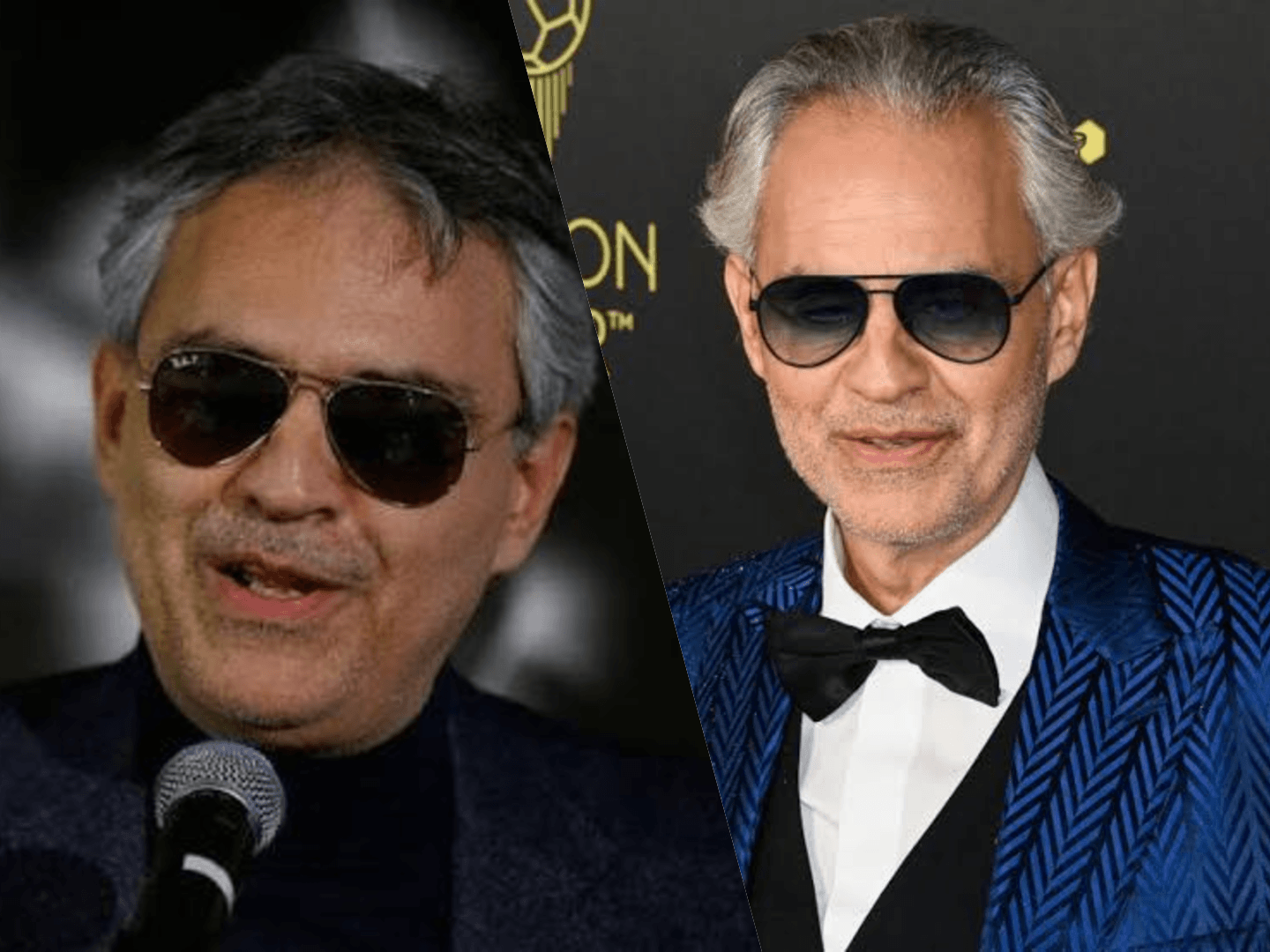
Yes, Andrea Bocelli is completely blind. The Italian tenor was born with severe visual impairment caused by congenital glaucoma and lost the remainder of his sight at age 12 after a soccer accident. Despite becoming blind during childhood, Bocelli developed an extraordinary musical career spanning opera, classical crossover and popular music.
Andrea Bocelli’s Vision: What Happened?
Andrea Bocelli was not born completely blind. According to accounts from Bocelli and his family, he had serious vision problems from infancy because of congenital glaucoma. His eyesight remained limited throughout childhood and eventually disappeared completely after an accident when he was 12.
Bocelli discussed his childhood vision in the documentary Andrea Bocelli: Because I Believe, directed by Cosima Spender. He recalled that he could see objects from close range as a child and remembered colors and other visual details from his early years.
His brother Alberto also described the seriousness of Andrea’s condition during childhood. According to the documentary account, Andrea underwent numerous operations because of congenital glaucoma and eventually attended a boarding school for visually impaired children.
The distinction between visual impairment and complete blindness is important when discussing Bocelli. He had useful but severely restricted vision during his early years, whereas his sight was completely lost at 12 following the soccer injury.
When Did Andrea Bocelli Lose His Sight?
Bocelli lost his sight permanently at age 12. FIFA’s official profile states that he had congenital glaucoma and suffered an accident while playing goalkeeper, when a football struck him in the eye and caused the permanent loss of his sight.
Bocelli himself later described the incident in connection with the documentary about his life. He recalled playing soccer as a goalkeeper when the ball struck him in the face, causing a hemorrhage that resulted in the loss of his remaining vision.
The accident therefore did not create an entirely new visual condition from nothing. Bocelli already had a significant history of impaired sight, and the injury became the event that left him completely blind. This distinction is supported by both FIFA’s account and the documentary material.
His story is sometimes simplified online into the claim that a soccer ball suddenly made a normally sighted child blind. The documented history is more complicated because Bocelli had congenital glaucoma and significant visual impairment before the accident occurred.
Was Andrea Bocelli Born Blind?
No, Andrea Bocelli was not born completely blind. He was born with congenital glaucoma, a condition that severely affected his eyesight from infancy. His early experiences were therefore different from someone who had no visual perception from birth.
Bocelli has explained that he could see when he was young, although his vision was extremely limited. In the documentary, he recalled being able to see primarily from close range and retaining vivid memories of colors and the visual world he experienced as a child.
This background also explains why descriptions of Bocelli sometimes differ between sources. Some accounts emphasize that he was visually impaired from birth, while others focus on the soccer accident at 12. Both details can be accurate because his vision deteriorated over time before he ultimately became completely blind.Andrea Bocelli Quick Bio
| Field | Details |
|---|---|
| Full Name | Andrea Bocelli |
| Age | 67 (born September 22, 1958) |
| Birthplace | Lajatico, Tuscany, Italy |
| Nationality | Italian |
| Profession | Tenor, singer, recording artist |
| Height | Not reliably verified by an authoritative source |
| Education | Law, University of Pisa; Opera Singing, G. Puccini Music Conservatory, La Spezia |
| Years Active | 1990s to present |
| Notable Works | Con te partirò, Time to Say Goodbye, Romanza, Sì, Believe |
| Awards & Honors | Sanremo Newcomers winner (1994), World Music Awards, Crystal Award, Hollywood Walk of Fame star, Italian Order of Merit |
| Net Worth | No reliably verified figure from an authoritative source |
| Spouse | Veronica Berti, married since 2014 |
| Social Media | Official Instagram is linked through Andrea Bocelli’s official website |
Note: Bocelli was born with severe visual impairment and became completely blind at age 12. His official biography confirms his law degree from the University of Pisa and opera-singing degree from the G. Puccini Music Conservatory.
How Blindness Influenced His Musical Journey
Music became an important part of Bocelli’s life long before his international fame. His official biography states that his parents encouraged his musical talent and that he began studying piano when he was only six years old.
Bocelli continued developing his musical abilities while dealing with severe visual impairment. His early musical education eventually expanded beyond piano, while singing became the discipline that would ultimately define his professional identity and take him from small performances to major international stages.
His blindness did not prevent him from receiving formal education. Bocelli studied law at the University of Pisa, demonstrating that his life before international fame was not exclusively focused on becoming an opera singer. His professional path developed gradually alongside his musical ambitions.
Before achieving worldwide recognition, Bocelli spent time performing in piano bars. Those performances provided practical experience and helped him earn money while continuing to develop his voice and receive further musical training. His later career was therefore built over many years rather than appearing overnight.
Andrea Bocelli’s Education and Early Career
Bocelli’s education is an important part of his story because his career was not initially a straightforward journey from childhood music lessons to international opera. He completed his studies in law at the University of Pisa before ultimately committing himself to professional music.
While working as a pianist and singer, Bocelli continued developing his vocal technique. His official biography credits Franco Corelli as an important mentor who helped Bocelli improve his singing skills during the formative years of his professional development.
Bocelli’s early career also involved connections with established figures in Italian music. The official account of his career describes how his abilities eventually brought him into contact with influential artists and helped open opportunities that would take him beyond the piano bars where he had previously performed.
This period demonstrates why his blindness should not be viewed as the sole explanation for his success. His career also required years of musical training, vocal development, professional discipline and opportunities to perform for increasingly larger audiences.
Andrea Bocelli’s Breakthrough as a Singer
Bocelli’s major breakthrough came in 1994, when he entered the Sanremo Music Festival and won the newcomers’ category with “Il mare calmo della sera.” His official career history identifies the victory as the performance that launched him into the Italian music scene and wider international recognition.
The Sanremo success marked a significant change in Bocelli’s professional life. His debut album, also titled Il mare calmo della sera, followed that breakthrough and became the first in a long series of recordings that established his reputation in both classical and popular music.
Bocelli also began developing his opera career during the same period. His official biography records his 1994 debut in Macbeth, performed in several Italian cities, demonstrating that his ambitions extended beyond mainstream recordings and into the established operatic repertoire.
His rise was particularly notable because he succeeded across musical boundaries. Unlike performers known exclusively for opera or contemporary pop, Bocelli developed a career that connected traditional Italian vocal music with accessible crossover recordings and major collaborations.
Andrea Bocelli’s International Success
One of the recordings most closely associated with Bocelli’s international breakthrough was “Time to Say Goodbye,” his duet with British soprano Sarah Brightman. The song became a major international success and helped transform Bocelli from a respected Italian singer into a globally recognized performer.
Bocelli subsequently worked with major figures from different parts of the music industry. His official biography highlights collaborations and performances involving artists and conductors including Luciano Pavarotti, Céline Dion, Plácido Domingo, Zubin Mehta, Seiji Ozawa and Lorin Maazel.
His repertoire has also included major operatic works. The official biography lists recordings and performances connected with operas including Manon Lescaut, Turandot, Aida, La forza del destino and Lucia di Lammermoor. These projects demonstrate his continued involvement with traditional opera alongside his crossover work.
Bocelli’s commercial reach is equally substantial. His official website states that he has sold more than 90 million albums worldwide, a figure that places his career among the most commercially successful in classical and crossover music.
His achievements have also been recognized outside the recording industry. Bocelli received a star on the Hollywood Walk of Fame in 2010, according to his official biography, further reflecting his international cultural impact.
How Does Andrea Bocelli Perform Without Sight?
Bocelli’s ability to perform professionally without sight is connected to his extensive musical training and experience rather than any ability to see the stage. He has spent decades developing his voice, learning repertoire and performing with orchestras, conductors, instrumentalists and fellow singers.
Professional musical performance relies heavily on auditory information, memorization, rehearsal and communication with other musicians. Bocelli’s career demonstrates how a singer can work at the highest professional level while being unable to rely on visual cues in the same way sighted performers do.
His performances also involve conductors and orchestras that provide musical coordination. Bocelli’s official biography records his work with internationally recognized conductors including Zubin Mehta, Seiji Ozawa and Lorin Maazel, showing the sophisticated musical environments in which he has performed.
Bocelli has also spoken about performing without being able to see the audience. In a CBS interview, he explained that applause provides an emotional connection with listeners and described the responsibility he feels when audiences respond to his performances.
His experience offers an important perspective on blindness. It does not mean that a person cannot participate in demanding professional environments. Bocelli’s career instead illustrates how specialized skills, training, technology, collaboration and adaptation can support a highly accomplished professional life.
Andrea Bocelli’s Blindness in His Own Words
Bocelli has not always wanted his blindness to dominate public discussion about him. Earlier interviews noted that he was reluctant to make his sight loss the central subject of his public identity, preferring attention to his music and other aspects of his life.
His more recent documentary provided a rare opportunity to hear him discuss his childhood vision and the event that ended his remaining sight. The film presents those experiences as part of a much larger personal and musical story rather than as the entire explanation for his achievements.
One particularly important detail from his account concerns visual memory. Bocelli explained that he remembers the world he saw as a child, including its colors. That recollection helps clarify that his visual experience before complete blindness was different from that of someone blind from birth.
The documentary also includes reflections from Bocelli’s family about his childhood and his attitude toward adversity. His mother described how he rejected being treated as a helpless child, while the film presents his determination as a recurring element of his personal story.
Andrea Bocelli’s Legacy Beyond His Blindness
The question “is Andrea Bocelli blind” has a straightforward answer, but his biography extends far beyond his disability. He became one of the world’s most recognizable tenors through sustained musical development, international performances, recordings and collaborations across multiple genres.
His career also challenges the tendency to describe successful blind performers primarily through their disabilities. Bocelli’s blindness is an important part of his personal history, but his professional achievements involve vocal technique, interpretation, repertoire, discipline and decades of experience.
That distinction matters because Bocelli has performed both demanding operatic repertoire and widely accessible popular songs. His ability to move between those worlds helped create a career that reaches audiences who may have little previous connection with opera.
His story is also different from the familiar image of an artist who became famous immediately after overcoming one dramatic obstacle. Bocelli’s path included childhood musical education, formal university study, piano-bar performances, vocal training and years of professional development before international success arrived.
The official biography’s record of his career illustrates that progression clearly. His 1994 Sanremo victory, opera work, international recordings, collaborations and later recognition all formed part of a decades-long career rather than a single breakthrough moment.
Andrea Bocelli’s Vision Today
Andrea Bocelli remains completely blind. The official documentary describing his life explicitly refers to his loss of sight at age 12, while FIFA and other reputable sources independently document his congenital glaucoma, childhood visual impairment and permanent blindness following the soccer accident.
There is therefore no credible basis for claims that Bocelli regained his sight or is merely partially blind today. His public performances, interviews and biographical records consistently identify him as a blind singer who has continued performing internationally for decades.
His blindness has also not prevented him from maintaining a demanding professional schedule. The documentary Andrea Bocelli: Because I Believe follows him during performances and offers an intimate view of his life after three decades as an internationally established artist.
For readers searching for is Andrea Bocelli blind, the most accurate conclusion is that he was severely visually impaired from childhood and became completely blind at 12. The condition has remained permanent, while his music career has continued to grow internationally.
Conclusion
Andrea Bocelli is completely blind, but he was not born without sight. He lived with congenital glaucoma and severe visual impairment from infancy before losing his remaining vision permanently at age 12 after a soccer accident. These details are supported by Bocelli’s own accounts, FIFA and his official documentary.
His blindness became one part of a much broader life story involving music education, university study, vocal training and years of professional work. His breakthrough at the 1994 Sanremo Music Festival ultimately led to an international career spanning opera, classical crossover and popular music.
Today, Bocelli is recognized not simply as a blind singer but as an internationally celebrated tenor whose career has lasted for more than three decades. His story combines significant personal challenges with exceptional musical achievement, making his vision history an important part of his biography without defining the whole of it.FAQs About Andrea Bocelli
Is Andrea Bocelli completely blind?
Yes. Andrea Bocelli is completely blind. He had severe visual impairment from childhood and lost his remaining sight permanently at age 12 following a soccer accident.
Was Andrea Bocelli born blind?
No. Bocelli was born with congenital glaucoma, which severely affected his vision from infancy. He retained limited sight during childhood before becoming completely blind at 12.
How did Andrea Bocelli lose his sight?
Bocelli lost his remaining vision after a soccer accident at age 12. He was playing goalkeeper when a ball struck him in the face, causing a hemorrhage that resulted in permanent blindness.
Did Andrea Bocelli’s blindness stop his music career?
No. Bocelli continued his musical education and eventually became one of the world’s most successful tenors. His 1994 Sanremo Music Festival victory helped launch his professional recording career internationally.
Can Andrea Bocelli see anything today?
No. Bocelli is completely blind and has remained so since childhood. His decades-long career demonstrates that blindness has not prevented him from performing opera, classical crossover and popular music at an international level.
